Printable polar graph paper PDF
Concentric circles and radiating lines for plotting r and θ. Choose the ring spacing, the angle between rays and how often degrees are labelled.
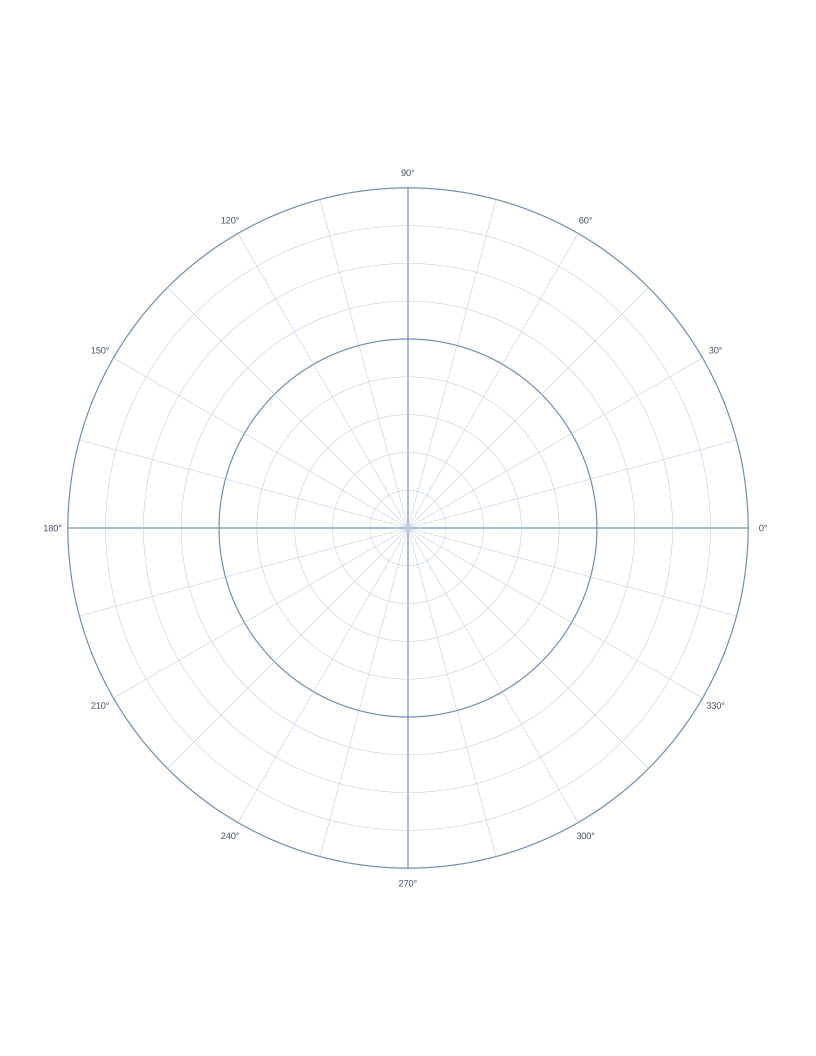
Ready-to-print polar graph paper PDFs
One-click downloads with the preset settings and a 10 mm margin. They print at actual size.
About polar graph paper
Polar graph paper locates points by distance and direction instead of by x and y. Concentric circles show the distance r from the centre, and straight rays show the angle θ. This makes it the natural paper for polar equations such as roses, cardioids and spirals.
The same paper is used for radar and antenna patterns, wind roses, compass work and any chart where direction matters. A page with a ray every 15 degrees has 24 rays, and 5-degree paper has 72.
The generator draws a single large polar plot centred on the page. Degree labels sit around the edge of the circle, and every fifth ring is heavier so you can read distances quickly.
What you can use it for
- Graphing polar equations in precalculus and calculus
- Radiation pattern, radar and sound directivity plots
- Wind and navigation charts
- Complex numbers on the Argand plane
- Circular design and mandala sketches
The options explained
- Ring spacing. Distance between circles. Wider rings leave space for pencil marks.
- Heavier ring every. Emphasises every nth circle for easier counting.
- Angle between rays. 5, 10, 15, 30, 45 degrees, or axes only.
- Degree labels. Turn the labels on or off, and choose how often they appear.
Printing tips
- Use 15 degrees for most textbook problems, since common angles such as 30, 45 and 60 degrees land on rays.
- If you plot in radians, keep degree labels on and convert as you work.
- A4 or Letter portrait gives the largest circle. Landscape wastes the top and bottom of the sheet.
For more detail, read the guide to printing grid paper at true size.
Frequently asked questions
How do I plot a point on polar paper?
Find the angle on the labelled rays, then count rings out from the centre to the value of r.
Does the paper have a scale for r?
Rings are evenly spaced. Decide what each ring represents, for example 1 unit, and number them yourself.
Which angle spacing is best?
15 degrees for school work. Use 5 degrees for precision and 30 degrees for simple demonstrations.
Can I print radians?
Labels are in degrees. Radians can be written by hand next to them.