Printable hexagonal graph paper PDF
A honeycomb of regular hexagons. Choose the hexagon size and whether the points face up or sideways, then download the PDF.
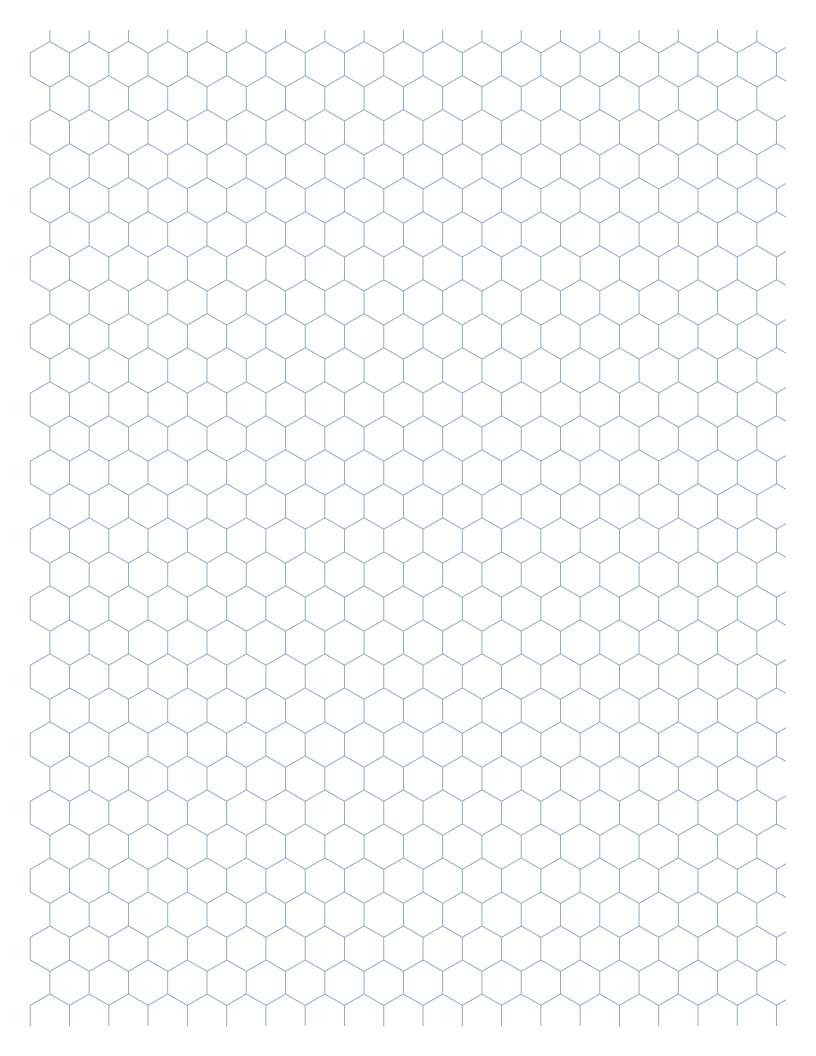
Ready-to-print hexagonal graph paper PDFs
One-click downloads with the preset settings and a 10 mm margin. They print at actual size.
About hexagonal graph paper
Hexagonal graph paper tiles the page with regular six-sided cells. Every cell touches six neighbours at equal distances, which is not true of squares, where diagonal neighbours are further away than side neighbours. That equal distance makes hex grids popular for game maps and movement rules.
The pattern also appears in nature and chemistry. Benzene rings and other carbon structures are drawn on hexagons, and beehive cells, basalt columns and many crystal lattices follow the same layout.
Pick the hexagon side length to set the scale. Small cells suit organic chemistry diagrams, medium cells suit game maps, and large cells work for posters and classroom activities. Pointy-top cells have a vertex at the top, and flat-top cells have an edge at the top.
What you can use it for
- Tabletop and wargame maps, and role-playing dungeons
- Organic chemistry skeletal structures
- Tessellation and geometric patterns
- Quilting, mosaic and tile layouts
- Teaching area and symmetry
The options explained
- Hexagon side length. The length of each edge. The presets cover 4, 6, 8 and 12 mm.
- Orientation. Pointy top has a vertex at the top. Flat top has a flat edge there.
- Line thickness and colour. Make the lines thicker for maps that will be coloured in.
Printing tips
- For game maps, 12 mm sides give cells that fit miniature bases.
- Print on card stock for durable game boards.
- Flat-top grids use columns that stagger up and down, and pointy-top grids use staggered rows. Match the layout your game rules assume.
For more detail, read the guide to printing grid paper at true size.
Frequently asked questions
Is the hex grid regular?
Yes. Every hexagon is regular, with six equal sides and six equal angles.
What size hexagons are used in chemistry?
Small cells, around 4 to 6 mm, leave room for bond labels and substituents.
Can I make a hex map for a role-playing game?
Yes. Use the large or flat-top preset, print it on card, and draw terrain with pencil.
What is the difference between pointy and flat top?
It is a rotation by 30 degrees. Pointy-top cells form horizontal rows, and flat-top cells form vertical columns.